
How Human Services Leaders Can Transform Technology Funding Strategy in the Age of AI

Nonprofit human services leaders are facing growing pressure from their boards to adopt AI to meet rising demand for services and ease growing burnout among their staff. Yet, they’re stuck dealing with an outdated grant funding cycle that treats technology as an administrative luxury rather than an essential service delivery tool. As post-pandemic service delivery has proven, technology is no longer an optional luxury.
On top of that, rigid grant allocation rules, shrinking funding streams, and a lack of reliable impact data make the hurdles even higher. However, modernizing your technology funding strategy to adapt to this AI era is entirely possible through this repeatable process:
Reframe IT as direct service delivery: Stop burying technology in general administrative overhead. Use joint cost allocation methods and federal compliance criteria (necessity, reasonableness, allocability, and consistency) to bill software, enterprise CRM platforms like Salesforce, and AI tools as direct program expenses.
Build funder trust through authenticity: Build strong relationships with funders. Be transparent about the realities you face and engage them 12 to 16 months before making a formal ask.
Avoid the generic AI proposal trap: Copy-pasting the same AI-generated grant proposals as your competitors strips away your authentic voice and lowers win rates. Instead, ground applications in internal program data and use AI internally to stress-test your KPIs.
Reframing Software and AI from Overhead to Direct Program Costs
For decades, nonprofit financial models have been constrained by the myth that technology is purely an overhead expense. When budgets tighten, administrative overhead is the first line item cut, leaving agencies stuck with outdated software that makes service delivery harder. To fund modern tools like AI, human services leaders must shift funder mindsets to view technology as a core programmatic tool essential to service delivery.
That’s why your intended AI use case should support a vital operational workflow instead of merely serving as a band-aid on a broken process. Funders will demand evidence of this alignment, which requires documenting the exact workflow your team uses to deliver services. Once you map out those workflows step-by-step, you can prove to funders and auditors that the software is a required tool for helping clients—not administrative fluff.
Navigating Grant Rules with Joint Cost Allocation
Here’s one specific way that grant-funded human services agencies can successfully position technology as a direct programmatic expense: leverage joint cost allocation. Just as a clinical facility allocates utility costs like electricity proportionally across programs, digital infrastructure and enterprise CRM systems like Salesforce used by program staff can also be allocated directly to specific grant budgets.
To pass federal grant audits, tech investments must satisfy four core financial principles outlined in the Code of Federal Regulations (CFR):
Necessity: You must document and prove that the software or AI capability is required to execute the program.
Reasonableness: Costs must align with fair market rates for the specific service delivered.
Allocability: Expenses must be proportionally distributed based on actual program usage or constituent consumption.
Consistency: The allocation methodology must be applied uniformly across every program in the organization.

This is part of your playbook to move away from survival-driven annual budgeting toward long-term 3-to-5-year outlooks, ensuring that both initial implementation fees and ongoing subscription costs are fully sustained across multiple budget cycles.
Build Relationships With Funders to Win Trust Long Before the Application
An airtight financial model in a grant proposal will only get you so far. Without strong funder relationships, you’ll struggle to secure backing for innovative tech that doesn't fit neatly into traditional grant templates. Funders do not just invest in software. They invest in leaders who are transparent about their operational realities. Rather than presenting a sanitized story of perfection, earning grantmaker trust starts long before an application deadline by having honest, human conversations about your legacy challenges and sharing a clear multi-year vision for mission impact.
Translating Tech for Non-Technologists
Another way to show authenticity to funders is to speak to them like people, not technologists, because most of them aren’t. Avoid technical jargon, focus on human-centered use cases, and be honest about your operational friction points:

Acknowledge legacy gaps openly: Explain what your agency cannot currently do due to outdated tech—such as pulling real-time demographic data or tracking multi-generational household outcomes.
Frame tools around staff & client outcomes: Demonstrate how live Salesforce dashboards and automated intakes free up caseworkers to spend more direct, high-quality time with families.
Establish a multi-year planning runway: Begin relationship-building conversations 12 to 16 months before making a formal ask, securing backing for a 5-year transformation plan rather than chasing short-term, 12-month fixes.
Inspect under your own hood: Bring in neutral third-party technical experts early to evaluate your infrastructure, ensuring your funding ask reflects actual technical readiness.
Why Generic AI-Written Proposals Fail, and How Data Closes the Loop

Securing initial grant dollars with a creative budget and strong funder relationships is only half the battle. You must then sustain that funding by continuously proving impact. However, with virtually all nonprofits now using AI to write their applications, competition for those dollars has intensified.
Foundation officers report receiving up to nine times the volume of applications compared to previous years, most of which sound like the exact same sanitized, AI-generated template. Grantmakers recognize when a proposal lacks authenticity, and they are unlikely to back nonprofits that sacrifice their unique organizational voice to cut corners during the application process.
Stress-Testing Data With AI to Build a Defensible Position
Instead of using AI to generate cookie-cutter grant applications that sound just like everyone else, here’s a better way to use AI: stress-test your program data and organizational narrative before facing funder scrutiny by prompting AI tools to act as a strict federal grant reviewer who is identifying weak links between your programs and long-term client outcomes.
During this process, maintain your authentic organizational voice by grounding every request from the AI in real, internal program metrics rather than vague, AI-written promises every other organization makes. Then, when proving the value of your tech investment, never claim that saving staff time is the end goal. Funders do not fund efficiency for its own sake. They want to know how that newfound time will be reinvested into seeing more clients or improving service quality.
Taking this approach during your mock application review with AI will reveal how your organizational story may resonate with real funders. That’s a true strategic approach for using AI to renew technology funding instead of a corner-cutting approach, closing the modern funding loop.
The Playbook for Nonprofits to Elevate Funding Strategy
To transform your funding model in the age of AI, you must reframe technology as a direct program cost, build authentic multi-year relationships with grantmakers, and ground grant proposals in authentic, verified impact data. As a leading Salesforce strategy and technology partner for human services organizations, Provisio is here to help you secure the necessary funding for technology and implement it for maximum impact for the people you serve.
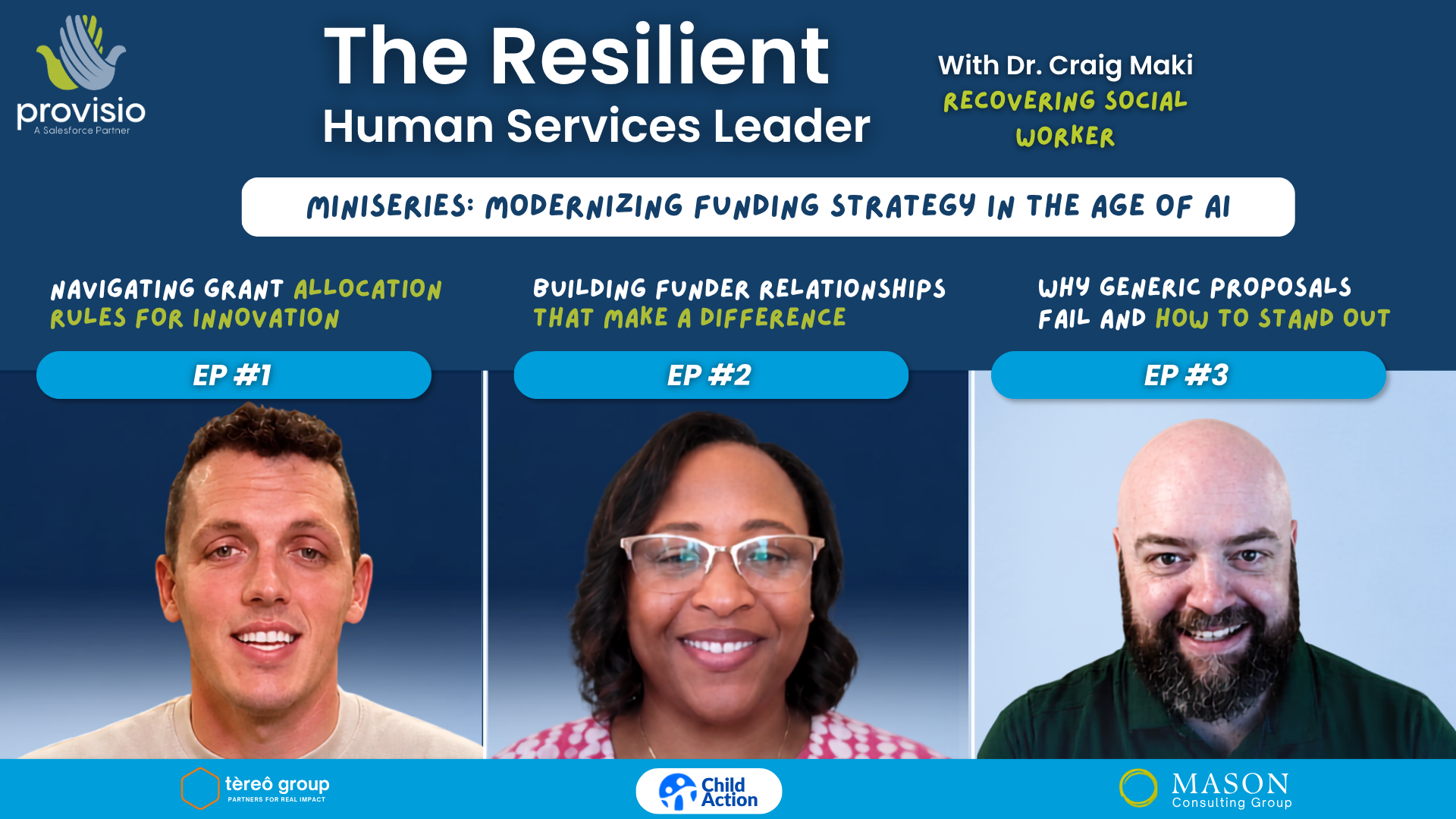
Sourced from The Resilient Human Services Leader Miniseries
The insights shared in this article are derived from the 3-part funding miniseries of The Resilient Human Services Leader, hosted by Provisio Chief Strategy Officer Craig Maki.
Episode 1 - Funding the AI Journey: Navigating Grant Allocation Rules for Technology
Chris Shue, co-founder of the Tereo Group, explains how human service leaders can navigate rigid grant allocation rules to successfully position AI and modern technology as a programmatic necessity rather than just an administrative cost. From reframing IT away from traditional overhead to applying joint cost allocation methods, Chris shares key financial lessons, practical steps, and strategic frameworks to secure grant funding for modern technology within grant-based accounting.
-
-How to shift away from a scarcity budgeting mindset and position AI tools as direct drivers of program delivery
-Why evaluating technology through standard federal accounting principles—necessity, reasonableness, allocability, and consistency is crucial for grant compliance
-Practical strategies to build a compelling business case for tech investments that balance financial discipline with long-term program efficacy
Episode 2 - The Interpersonal Approach: Building Funder Relationships That Make a Difference
Dr. Juanita Reynolds, Chief Operations and Program Officer at Child Action, shares how nonprofit leaders can navigate funder relationships, state and county dynamics, and the human side of securing support for major technology initiatives. From presenting an authentic organizational narrative to establishing a 5-year vision, Dr. J shares key lessons, practical steps, and interpersonal strategies to earn funder trust and secure sustainable backing.
-
-How to build authentic trust with state, county, and philanthropic funders by maintaining transparency about legacy systems and programmatic gaps
-Why adopting a multi-year planning horizon, rather than relying on single-year grant cycles, is critical for securing sustainable technology investment
-Practical strategies for non-technologists to communicate complex technology needs through real-life use cases and human-centered mission impact
Episode 3 - The AI Grant Trap: Why Generic Proposals Fail and How to Stand Out
Fearghal Reid, co-founder of MASON Consulting Group, highlights how human services organizations can harness trusted data to demonstrate impact, support their next funding request, and build a stronger case for sustainable technology investment. From stress-testing KPIs internally with AI to protecting an agency’s authentic voice in grant proposals, Fearghal shares key lessons, practical steps, and strategic insights to close the modern funding loop.
-
-How to leverage internal program data to prove impact and present a compelling, data-grounded narrative for your next funding cycle
-Why using AI internally to stress-test metrics and program alignment builds a far more defensible position before facing funder scrutiny
-Practical strategies to demonstrate how technology-driven time savings directly enhance constituent service delivery and long-term program sustainability
-
Yes, provided the technology is reframed from administrative overhead into a direct service delivery tool. Under federal grant accounting guidelines, software and AI expenses can be billed to grants if they satisfy four core compliance criteria: necessity, reasonableness, allocability, and consistency.
-
Yes. When configured as a primary case management or client service system, Salesforce licensing, implementation, and AI capabilities can be billed directly to grants through joint cost allocation methods under federal CFR compliance guidelines.
-
Nonprofits can use joint cost allocation methods. Just as a clinical facility allocates utility costs like electricity across programs based on space usage, shared digital tools and AI infrastructure can be allocated directly across specific program budgets based on documented usage and mapped service workflows.
-
Relying on single-year innovation grants or one-time gifts creates major financial risk when funding expires. Instead, leaders should establish a 3-to-5-year financial horizon that incorporates ongoing operational costs into recurring program budgets and engages grantmakers 12 to 16 months ahead of time to co-design multi-year funding runways.
-
Relying on generic AI prompts to write entire grant narratives often results in cookie-cutter proposals that strip away your agency’s authentic voice, lowering win rates in competitive grant cycles. Instead, nonprofits should ground applications in internal program data and use AI internally to stress-test key performance indicators and logic models before submitting.
-
Avoid technical jargon and system architecture specs; instead, frame technology requests around human-centered use cases. Be transparent about your legacy system gaps and show funders how tools like live dashboards or automated intakes directly allow caseworkers to spend more quality time serving families.
-
Funders do not fund efficiency or staff time savings for their own sake. Applications and reports must explicitly demonstrate how administrative time bought back through technology will be reinvested into seeing more clients, improving care quality, or driving better constituent outcomes.
