

When a resident walks into a county office or visits a municipal website seeking help, they are rarely facing just one isolated challenge. For instance, a family facing eviction often needs emergency rental assistance, food support, workforce development, and child care services all at once. Yet in most local and county governments, each of these services operates out of siloed systems.
The result is a frustrating experience for constituents, significant administrative burden for staff, and an executive leadership team left without cross-program visibility into community needs, service gaps, or provider performance. By implementing an AI-ready Front Door Solution built on Salesforce Public Sector Solutions, agencies can unify intake, consolidate data, and establish the foundational architecture required for safe, effective public sector AI.
Executive Summary & Key Takeaways
Unified Resident & Staff Access: Provisio’s CAUSE Front Door Solution connects an anonymous public screening site, an authenticated resident portal, and a centralized staff workspace on Salesforce Public Sector Solutions (PSS).
Closed-Loop Referrals & SDoH Alignment: Universal intake organized around Social Determinants of Health (SDoH) pairs with real-time provider capacity tracking to eliminate referral black holes.
Strict AI Governance: Official eligibility determinations remain 100% deterministic and rules-based—never decided by AI, while Salesforce Agentforce supports staff with grant rule drafting, client summaries, and conversational guidance.
Phased Modernization: Agencies integrate directly with existing platforms (such as HMIS and LIHEAP) rather than executing a risky, multi-year overhaul.
Why Accumulating Point Solutions Fails Public Sector Agencies
Over decades of federal, state, and local grant funding cycles, agencies have accumulated a suite of point solutions that fragment their data across siloed tools. Direct assistance teams work out of spreadsheets, homelessness services run on specialized HMIS databases, and contracted community providers track their own client rosters in separate portals.
This fragmentation creates severe operational bottlenecks:

Resident Retraumatization & Paperwork Fatigue: Constituents are forced to navigate a labyrinth of disconnected departments, filling out repetitive forms and re-explaining their most vulnerable circumstances at every counter.
Blind Spots in Care Coordination: Staff working within one division have no visibility into the active benefits, care plans, or referrals an individual or household receives from another division or partner provider.
Provider Disconnect & Referral Black Holes: Staff make outbound referrals without visibility into contracted provider capacity, meaning clients are frequently routed to organizations with closed waitlists or no immediate openings.
Unstructured, Trapped Data: Critical eligibility indicators and social context aren’t able to be extracted from siloed PDF attachments, case notes, and email threads.
Lack of AI Readiness: Agencies face immense pressure to adopt AI, but AI doesn’t work well with siloed spreadsheets, duplicative records, and unstructured databases.
The Solution: Provisio’s Unified Front Door Built for Human Services
A Front Door solution relieves these burdens by establishing three interconnected experiences across the human services ecosystem:
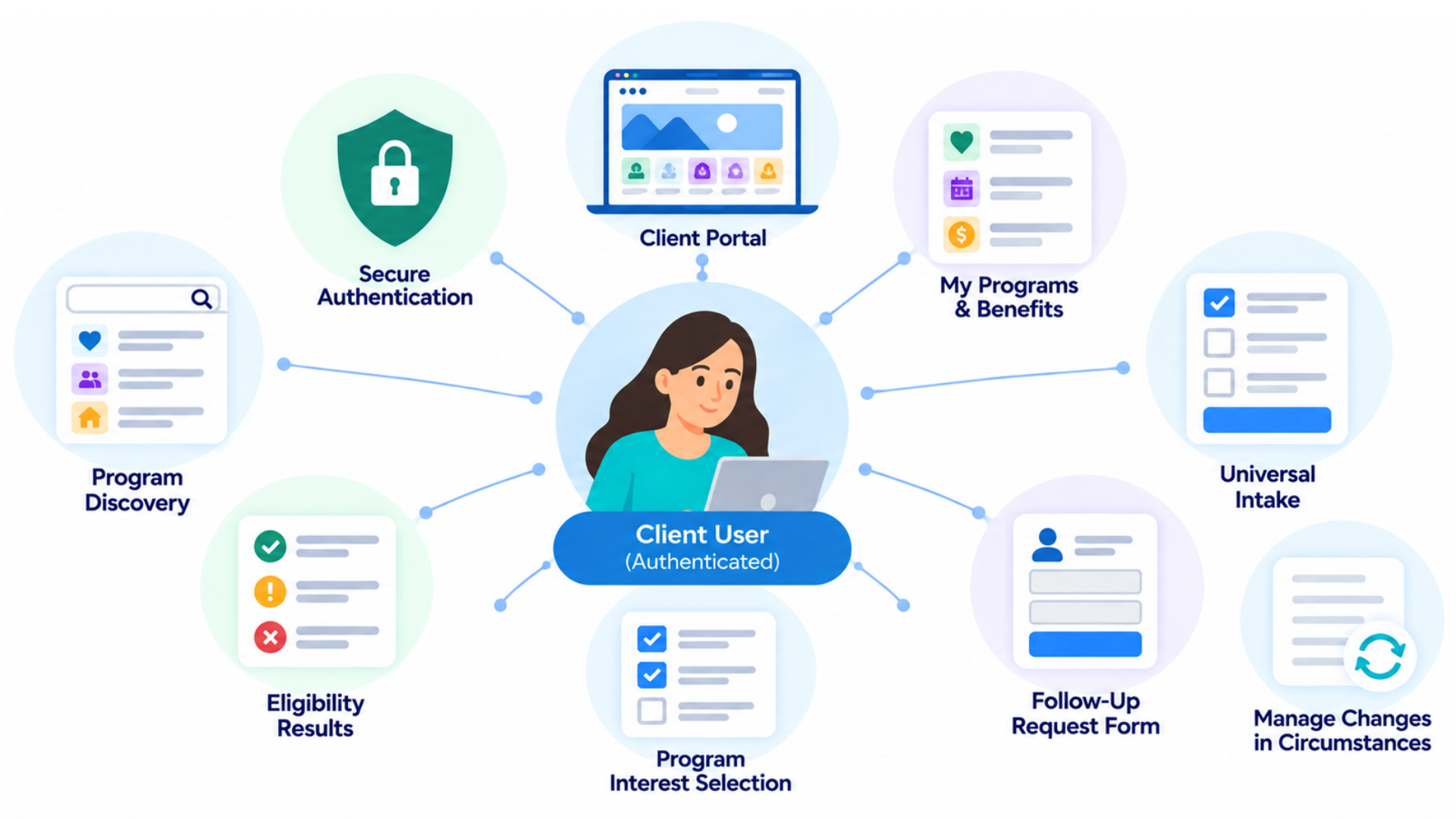
An Accessible Public Experience: An anonymous, low-barrier entry point where community members browse a catalog of programs, complete a brief screening, and view potential eligibility before deciding whether to request a follow-up.
A Secure Client Experience: A personalized portal where registered residents securely view their active enrollments, track benefits received to date, and report life changes without starting from scratch.
A Dedicated Staff Workspace: A centralized application where intake workers, caseworkers, and leadership manage households, programs, provider networks, rules-based eligibility determinations, and wraparound care plans.
Provisio deploys this framework using our CAUSE Front Door Solution paired with the Front Door Eligibility Engine, built natively on Salesforce Public Sector Solutions (PSS).
The Core Operational Questions to Organize Services Around a Household’s Social Determinants of Health (SDoH)
1. “Who is this person, what kind of help might they need, and what programs are they already connected with?”

Right now, seeking help usually means a family has to start the intake process from scratch with every single department. That can be very frustrating. The Front Door simplifies that by sharing a household profile across departments that captures a family’s core story once, cutting out redundant paperwork for good.
An Easy, Private First Step: Residents shouldn't have to create an account, remember a password, or hand over personal contact information just to find out what's available. By answering a quick, intuitive set of 10 to 13 questions online, they can instantly see which county or community programs they might qualify for.
A Direct Line to the Right Team: When an individual sees a program they want to pursue and asks for help, the system connects the dots behind the scenes. It checks if they're already in the system to avoid duplicate files, creates a profile if they're new, and immediately routes a clear request to staff so someone can follow up.
2. “What help is this person actually receiving right now, and what’s their current status?”

From the staff perspective, it is often surprisingly difficult to see what services different departments are providing a resident. This layer gives frontline workers and leadership a single, clear window into all the support a household is receiving.
Tracking Every Kind of Support: Whether a program provides direct financial assistance, physical goods like food boxes or infant supplies, or specialized services like counseling, staff can log and track it in one shared space.
Seeing the Whole Picture: Instead of guessing or logging into three different systems, caseworkers can see active enrollments and benefit histories at a glance. This prevents families from receiving overlapping benefits by mistake, shows what has already worked, and highlights unaddressed needs before a crisis escalates.
3. “How do we work with someone over time so they can reach real, lasting stability?”

Real stability isn't built on one-off transactions. Whether a resident needs a fast answer or months of guided care, staff have the flexibility to manage both tracks of care seamlessly:
Quick Follow-Ups: For simple requests or immediate program interest, staff can quickly reach out, answer questions, and connect residents to the right department without unnecessary delays or paperwork.
Ongoing Wraparound Care: When a household faces deeper, overlapping challenges, staff across different programs can rally around the family. Teams work out of a single care plan, track personal goals together, and stay connected with the resident as they build a path toward long-term stability.
Real-Time Provider Capacity, Closed-Loop Referrals, & Simpler Management of Changes in Circumstances
Another major benefit of a Front Door solution for public sector agencies is how it streamlines coordination with community partners. Since the Front Door tracks both operational status and real-time provider capacity (e.g., Accepting Clients, Limited Capacity, At Capacity), when staff create a referral, available providers are automatically filtered to those with open capacity. Outgoing referrals also package the client's intake context and eligibility breakdown, allowing community partners to engage immediately without putting the resident through another round of screenings.
Finally, a Front Door solution also allows residents and staff to easily update changes in circumstances, like a drop in income or a new family member. When something changes with a resident, the Front Door allows either the resident or staff to update the Universal Intake with prior information pre-populated. Each submission is archived as a distinct, point-in-time record, preserving a clear audit trail of household progress over time while sparing constituents the burden of re-entering basic biographical facts.
Clean Data & Connected Systems for Responsible AI Adoption

It is vital that public sector agencies begin adopting AI, but AI is only as dependable as the data behind it. You cannot safely deploy AI in human services across disconnected spreadsheets, paper files, and fragmented legacy databases.
The great thing about a unified Front Door solution is that its core structure inherently prepares your agency for AI. By organizing services around a single household profile, standardizing intake data, and establishing clear role-based access, the Front Door creates the exact, trusted data foundation AI needs to thrive. Rather than treating AI as a separate, risky experiment, building a Front Door is merely the first step toward adopting AI that respects strict compliance rules, automates tedious administrative work, and helps caseworkers serve families faster.
Why AI Never Determines Eligibility
Public sector program eligibility is governed by statutory law, grant mandates, and strict compliance standards. That is why official eligibility determinations are handled strictly by a deterministic rules engine instead of AI. Resident criteria are evaluated against active policy rules to produce transparent results so there’s always a clear, auditable breakdown of why a household qualifies or what documentation is missing.
How AI Is Utilized in the Front Door Solution
While AI does not decide who qualifies for assistance, Salesforce Agentforce AI acts as an administrative accelerator to relieve staff burden across three primary areas:
Fast-Tracking Program Setup: Setting up a new state or federal grant usually requires staff to comb through 80+ pages of dense policy manuals. AI reads these agreements, extracts the core eligibility criteria, and drafts policy rules as inactive suggestions for staff to review, adjust, and activate—shortening program rollout from months to days.
Instant Client Summaries: Rather than spending valuable time reading through pages of historical case notes, caseworkers receive an automated snapshot of a household’s history, active benefits, and primary needs across major life areas before an interview begins.
Conversational Staff Guidance: An internal AI assistant helps staff quickly understand complex program options for walk-in residents or callers. Caseworkers can discuss a client’s unique situation in natural language to identify relevant programs, spot missing documentation, and determine the best next steps before running formal screenings.
A Phased Implementation Approach to Keep Operations Running Smoothly

The outcomes of a Front Door solution are game changing for state & local governments. However, it’s just as important how it’s implemented, because agencies cannot simply shut down critical operations while waiting years to complete a massive software overhaul. That is why Provisio’s Front Door model relies on a practical, phased implementation strategy that delivers quick operational wins which can be built upon later with new capabilities.
Phase 1: Immediate Operational Wins & Core Foundation. Rather than discarding specialized platforms that work, the Front Door connects to existing tools—such as mandated Homeless Management Information Systems (HMIS), utility portals (LIHEAP), or specialized grant databases. Staff immediately gain unified intake, shared household profiles, provider capacity visibility, and rules-based eligibility screening.
Phase 2: Expanded Access & Intelligence. Once the core data model is stable, agencies layer on advanced resident capabilities at their own pace. This includes launching multilingual, accessible resident self-service portals, automated SMS outreach, community kiosks, and geographic mapping to visualize community needs.
By modernizing in practical stages, agencies accelerate time-to-value, reduce implementation risk, and give staff time to adapt.
The Benefits of Provisio’s Front Door for Residents, Staff, & Leadership
With a Salesforce-powered, AI-ready Front Door solution, public sector agencies can transform the experiences of residents, staff, and leadership:
For Residents: A dignified, accessible entry point. Whether browsing anonymously from home or meeting with a caseworker, constituents tell their story once, discover services they didn't know existed, and receive coordinated support.
For Staff: Less time spent re-keying data between spreadsheets and hunting down paper files, freeing up capacity to focus on high-impact case management and direct client advocacy.
For Executive Leadership: Near-real-time visibility into county-wide resource allocation, provider capacity bottlenecks, and cross-departmental demand patterns, turning disconnected reporting into strategic, proactive governance.
This is what it looks like when technology stops being an administrative hurdle for public sector agencies and becomes what it was always meant to be: a tool that truly improves the lives of citizens.
Frequently Asked Questions About Public Sector Front Doors (FAQ)
-
A public sector Front Door is a unified, resident-facing entry point built on Salesforce Public Sector Solutions (PSS) that replaces fragmented departmental intake, eligibility screening, and referral processes. Provisio’s CAUSE Front Door Solution allows residents to discover programs, complete an anonymous 10-to-13-question eligibility screening, and request coordinated support without repeating their story across agencies.
-
The solution tracks each community partner’s operational status alongside real-time capacity (such as Accepting Clients, Limited Capacity, or At Capacity). When caseworkers initiate an outbound referral, the system automatically filters for providers with open availability and packages the client’s intake context and eligibility breakdown so receiving partners can act immediately without re-screening the resident.
-
No. Official eligibility determinations are handled exclusively by a deterministic rules engine configured to match statutory laws, grant mandates, and active policy rules—ensuring every determination is transparent and auditable. Salesforce Agentforce is strictly utilized as an administrative co-pilot to draft inactive policy rules from grant documents for staff review, generate Social Determinants of Health (SDoH) client summaries, and provide conversational guidance to staff.
-
No. Provisio uses a phased implementation strategy that connects directly to mission-critical platforms—such as Homeless Management Information Systems (HMIS) and energy assistance databases (LIHEAP)—in Phase 1, allowing agencies to launch unified intake and referrals quickly before layering on multilingual portals, kiosks, and geographic mapping in Phase 2.
