
For mission-driven organizations, the pressure to modernize technology and navigate digital transformation is constant. Programs evolve. Community needs grow. Expectations around data reporting, compliance, and impact measurement increase. Yet, knowing that change is needed doesn’t always mean knowing where to begin. That was the position Inglis found itself in.
Inglis helps empower people with disabilities to achieve their goals and live life to the fullest, and it operates a wide array of complex community services. However, as Inglis experienced sustained growth and expanded its service lines, its technology infrastructure couldn’t keep up. Organic program expansion led to siloed software, manual operational workarounds, and fragmented constituent data, meaning legacy tools no longer reflected how the organization truly operated.
What Inglis needed wasn’t just a new software platform. It needed a holistic assessment of its current operational landscape and strategic alignment on where it needs to go. Only then could it implement scalable nonprofit technology designed to adapt for another 150 years.
About Inglis: Empowering Independence Through Innovative Disability Services
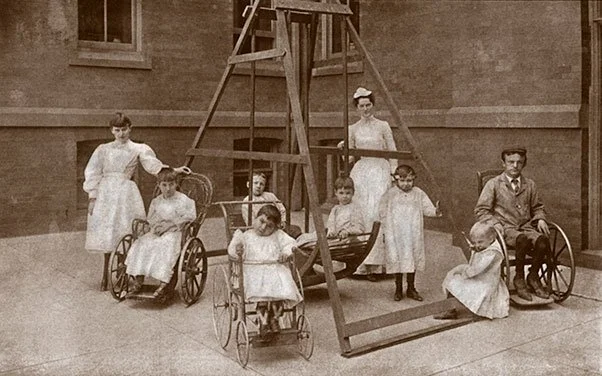
Inglis Children's Home opens, 1895
Based in Philadelphia, Inglis has helped people with disabilities for nearly 150 years through specialized service offerings include accessible housing, adapted technology services, employment services, peer mentoring, home modifications, community support programs, and specialized residential care.
Today, Inglis is the largest private provider of affordable accessible housing in the Greater Philadelphia region, supporting more than 2,000 people daily. At Inglis House, the organization’s specialty nursing care facility, it cares for 252 adults with physical disabilities and supports another 800 people living independently through community-based disability services.
Inglis remains deeply focused on sustainable growth, recently expanding its community reach through strategic affiliations to deliver vital resources and independent living support across the community.
The Challenge: Disconnected Systems and Rigid Software Not Built for Growth
Like many nonprofits, Inglis accumulated systems and processes incrementally as new programs launched. For nearly three years, internal discussions bounced back and forth between adopting an Electronic Health Record (EHR) or a Customer Relationship Management (CRM) platform. While clinical systems served specific health tracking needs, much of Inglis’ growth occurred in service-oriented, non-clinical programs—such as adapted technology and employment services—that required flexible constituent relationship tracking rather than rigid medical charts.
Without a unified nonprofit data architecture, individual teams turned to localized workarounds:
Program data was siloed in disconnected Excel spreadsheets and Microsoft Forms, restricting cross-team collaboration and client visibility.
Departments including IT, Compliance, and Development attempted to capture data independently without a central framework, leading to inconsistent impact measurement and reporting bottlenecks.
There was no centralized CRM database to manage relationships across clients, families, volunteers, and external partners.
Cross-program client referrals relied entirely on informal phone calls with no centralized tracking for referral volume, progress, or outcomes.
These operational challenges didn’t merely create administrative overhead. Without enterprise-wide visibility across programs, it became harder to demonstrate impact and plan strategically for future growth. Inglis recognized the need to modernize its nonprofit technology stack, taking a deliberate pause to align stakeholders and design a comprehensive path forward before investing in software implementation.
The Turning Point: Strategic Planning Before Technology Implementation

Prior to selecting external implementation partners, Inglis stepped back to complete an in-depth internal strategic planning initiative that established three overarching organizational priorities:
Demonstrate Impact: Deliver high-quality human services and accessible communities that enhance lives while expanding organizational capacity to measure and report outcomes.
Create a Unified Culture: Build a cohesive, mission-driven culture by strengthening core competencies aligned with organizational values.
Advance Financial Sustainability: Reduce operating losses, maximize operational performance, and diversify revenue sources to secure long-term sustainability.
With organizational goals established, Inglis needed to translate those priorities into an actionable technology strategy. That’s where Provisio came in, collaborating with Inglis’ cross-functional team to build a comprehensive strategic technology roadmap. By illustrating how a flexible Salesforce CRM differed from a rigid clinical EHR and directly supported Inglis’ non-clinical service expansion, Provisio provided the objective clarity needed to build consensus across program leadership, IT, and compliance.
Building a Strategic Roadmap Aligned With an Organizational North Star
Under Provisio’s strategic advising framework that drives every client transformation, Inglis underwent technology roadmapping that provided executive leadership with the necessary data-backed framework to compel the board to secure approval for Salesforce.
With institutional alignment in place, Inglis and Provisio mapped out critical baseline capabilities, executing a phased CRM implementation rather than attempting to deliver every feature at once. Inglis established a unified digital foundation powered by Salesforce Nonprofit Cloud and Provisio’s Front Door solution.
This centralized nonprofit technology foundation is designed to:
Centralize intake, referrals, and constituent relationship management across programs.
Improve visibility across departments, staff, community partners, and leadership.
Support standardized intake workflows without forcing rigid uniformity onto specialized service models.
Provide an adaptable platform where newly launched business lines can launch directly in Salesforce rather than in disconnected spreadsheets.
This digital foundation aligns directly with Inglis’ mission, anchoring future technology innovations designed to achieve its long-term strategic goals.
Early Signals of Impact: Breaking Down Silos and Improving Workflow Efficiency
While Inglis’ digital transformation roadmap continues to roll out in future phases, the organization is already realizing tangible operational value from the foundation established during the roadmapping process.
Teams are seeing measurable early wins:
Integrated Cross-Program Referrals: Staff can formally route and track client referrals directly within Salesforce—such as connecting adapted technology participants to employment services—logging over 20 cross-referrals in the first quarter alone.
Enterprise Visibility and Cultural Alignment: Staff have critical constituent data at their fingertips and can view cross-departmental activity for the first time, breaking down historic program silos and strengthening a shared sense of organizational mission.
Reduced Administrative Burden: Standardized intake workflows and centralized data entry replace manual spreadsheets, reducing redundant documentation and staff administrative load.
Centralized Enterprise Reporting: Clean, consolidated data equips executive leadership with real-time insight to support operational planning, grant reporting, donor storytelling, and financial sustainability.
These milestones highlight that successful digital transformation is driven not by technology alone, but by a strategic roadmap focused on operational intentionality, user adoption, and long-term scalability.
Positioned for What Comes Next: An AI-Ready Foundation
Perhaps the most significant outcome of Inglis’ strategic roadmapping effort is organization-wide clarity.
With stakeholders aligned on organizational goals and how technology supports them, Inglis is positioned to navigate continuous operational change. The scalable Salesforce architecture allows Inglis to seamlessly integrate growing service lines—such as expanding case management for its significantly enlarged employment services division. Furthermore, Inglis now has the clean data infrastructure required for upcoming roadmap milestones, such as legacy data integration through MuleSoft and Salesforce Data 360, as well as the responsible adoption of AI-enabled nonprofit insights.
Rather than allowing technology limitations to dictate operational growth, Inglis now has a strategic North Star guiding its digital journey. For Inglis, building an AI-ready future didn’t start with software. It started with a human-centered technology roadmap grounded in its mission to support independence for years to come.
If Inglis’ story inspired you, let’s talk about how Provisio’s strategic advising approach can also spearhead a more scalable, mission-aligned system transformation for your organization.
Frequently Asked Questions (FAQ)
-
If your organization offers a mix of clinical care and community-based services—such as assistive technology, job training, housing assistance, or peer mentoring—an EHR is often too rigid to track client relationships effectively. While EHRs are necessary for clinical charting and billing, human services programs require flexible constituent tracking across non-clinical touchpoints. Many organizations choose a centralized Customer Relationship Management (CRM) platform like Salesforce Nonprofit Cloud as their core relationship and intake hub, integrating specialized clinical or billing systems only where required.
-
Jumping straight into software procurement without organizational alignment often results in low user adoption, costly customization rework, and fragmented data. A strategic roadmapping process evaluates existing departmental workflows, uncovers hidden manual processes (like spreadsheets and forms), and directly connects technology requirements to high-level strategic goals. Developing this roadmap first gives executive leadership the data-backed business case and phased implementation plan needed to secure confident board approval.
-
In siloed organizations, cross-program referrals typically rely on informal phone calls and emails, leaving leadership with zero visibility into referral volume, follow-through, or outcomes. By implementing a centralized front-door intake system on a unified platform, staff can view a client’s complete history across all service lines, submit digital referrals directly to other internal programs, and automatically track whether those connections led to successful enrollment.
-
When organizations expand rapidly through new grants, pilot programs, or affiliations, teams often resort to quick-fix spreadsheets and forms that eventually become isolated data silos. Establishing a scalable CRM architecture with standardized intake and relationship frameworks allows leadership to quickly spin up new service lines inside the existing system from day one, rather than trying to clean up and integrate disparate databases years later.
-
Becoming AI-ready does not mean deploying automated tools or chatbots immediately. For human services organizations, AI readiness requires centralizing constituent data, standardizing intake workflows, and eliminating disconnected data silos. Machine learning and AI tools rely entirely on clean, structured, and consistent data; building a centralized data foundation ensures future AI initiatives deliver trustworthy, actionable insights rather than amplifying fragmented reporting.
