
For many nonprofits and human services organizations, data begins with good intentions. A team creates a spreadsheet to track referrals. A program manager builds a form to monitor client outcomes. A development team maintains a separate donor database. Finance keeps grant reporting in another system. Over time, these tools multiply until leaders are left with fragmented information, duplicate data entry, inconsistent reporting, and limited visibility into the full story of their impact.
That is where data modernization becomes essential.
A thoughtful data modernization strategy helps nonprofits move beyond disconnected spreadsheets and legacy systems toward integrated, secure, AI-ready technology that supports better decisions, stronger compliance, and more coordinated services. For organizations serving communities across housing, shelter, workforce development, behavioral health, aging care, early childhood, and other human services areas, modernizing data is not just a technical upgrade. It is a mission investment.
What Does Data Modernization Entail?
Data modernization is the process of improving how an organization collects, manages, integrates, governs, analyzes, and uses data. It often involves replacing outdated tools, reducing manual processes, connecting systems, improving data quality, and creating a single source of truth that teams can trust.
For nonprofits, data modernization may include:
Moving from spreadsheets to a centralized case management or program management system
Integrating fundraising, grants, program, and client service data
Standardizing how teams collect and define key information
Building dashboards that show real-time performance and outcomes
Strengthening data governance, privacy, and compliance practices
Preparing organizational data for responsible AI adoption
The goal is not simply to have more data. The goal is to make data more useful, accessible, accurate, secure, and aligned with your mission.
The Risk of Staying Stuck in Spreadsheet-Driven Systems
Spreadsheets can be useful for quick calculations, temporary tracking, or small datasets. But when spreadsheets become the backbone of service delivery, reporting, or compliance, they can create real organizational risk.
Common challenges include:
Data silos: Different teams maintain separate files with different versions of the truth.
Manual reporting: Staff spend hours compiling reports instead of analyzing results.
Limited visibility: Leaders cannot easily see program trends, service gaps, or client journeys.
Inconsistent definitions: One department may define “active client” differently from another.
Security concerns: Sensitive information may be stored, shared, or downloaded without enough control.
AI limitations: Disorganized or unreliable data cannot support meaningful automation or AI-enabled insights.
A successful data modernization strategy helps nonprofits replace these fragile workflows with systems that are more connected, scalable, and secure.
Key Signs Your Nonprofit Is Ready for Data Modernization
Not every organization begins data modernization from the same place. Some are replacing outdated systems. Others are trying to unify multiple programs after growth, mergers, new grants, or expanded service models.
Your nonprofit may be ready for data modernization if:
Staff enter the same data into multiple systems.
Program teams rely heavily on spreadsheets for day-to-day operations.
Reporting for funders, boards, or regulators takes too much manual work.
Leadership lacks real-time visibility into outcomes.
Client information is scattered across platforms.
Data quality issues make reports difficult to trust.
Systems do not reflect your current programs or workflows.
Your organization wants to explore AI but lacks clean, connected data.
Compliance requirements are becoming more complex.
Teams struggle to tell a clear impact story with data.
These pain points are not just technical problems. They affect staff capacity, client experience, funding opportunities, and strategic decision-making.
What a Successful Data Modernization Strategy Should Include
A strong data modernization strategy should be practical, phased, and mission-aligned. It should not begin with software selection alone. It should begin with the outcomes your organization wants to achieve.

1. A Clear Vision for Data Modernization
Start by defining what modernization should make possible. For a human services organization, the goal may be to create a more integrated service delivery model, improve client options, enhance operational efficiency, or meet regulatory requirements more effectively.
Questions to ask include:
What decisions do we need better data to support?
What client, program, or community outcomes do we need to measure?
Which processes create the most friction for staff?
What reporting obligations are most difficult today?
What data will we need to support future AI adoption?
How do we want to communicate impact to funders and stakeholders?
A clear vision helps prevent technology from becoming disconnected from mission.
2. A Current-State Data Assessment
Before modernizing, nonprofits need to understand what already exists. This includes systems, spreadsheets, workflows, reports, data owners, integrations, pain points, and compliance requirements.
A current-state assessment should identify:
Where data is collected
Who enters, owns, and uses each type of data
Which systems are connected or disconnected
Where duplicate records or inconsistent definitions exist
Which reports are mission-critical
Where security or compliance risks may be present
Which manual processes could be automated or redesigned
This step creates the baseline for a realistic data modernization roadmap.
3. Data Governance and Ownership
Modern systems still need strong human oversight. Data governance defines how data should be collected, named, stored, accessed, protected, and used.
For nonprofits, governance should answer practical questions such as:
Who owns client, program, fundraising, and grant data?
Which fields are required, optional, or sensitive?
How should staff define key metrics?
Who can access different types of information?
How are data quality issues reported and resolved?
What standards support privacy, compliance, and ethical data use?
Good governance does not have to be overly complex. It should make data easier to trust and easier to use.
4. System Integration and Centralization
Many nonprofits use different tools for case management, fundraising, grants, referrals, finance, communications, and reporting. Data modernization does not always mean replacing everything at once. In many cases, the goal is to connect the right systems around a stronger data model.
A modernized environment may include:
A centralized CRM or case management platform
Secure integrations between systems
Automated data flows
Standardized client or participant records
Shared reporting dashboards
Cloud-based data storage
Defined master data and taxonomy
Provisio’s approach to data management includes helping organizations merge, integrate, centralize, harmonize, standardize, evaluate, visualize, and communicate data so teams can better understand program impact.
5. Better Reporting and Data Visualization
Data modernization should make reporting easier, faster, and more meaningful. Instead of waiting weeks for manual reports, teams should be able to access reliable dashboards and visualizations that support action.
Modern reporting can help nonprofits track:
Program participation
Client progress and outcomes
Referral patterns
Service gaps
Grant performance
Staff capacity
Community needs
Funding impact
Compliance metrics
Dashboards can also help nonprofit leaders communicate impact more clearly to boards, funders, government partners, and community stakeholders.
6. Security, Privacy, and Compliance
Human services organizations often manage sensitive client and participant information. A responsible data modernization strategy must include security and compliance from the beginning.
This may involve:
Role-based access controls
Secure cloud storage
Data retention policies
Audit trails
Consent and privacy workflows
Compliance-aligned reporting structures
Clear policies for sensitive information
Staff training on responsible data use
Modernization should not simply make data more accessible. It should make data more accessible to the right people, in the right way, for the right purpose.
7. Change Management and Staff Adoption
Even the best system will fail if staff do not understand, trust, or use it. A successful data modernization strategy must include change management from the start.
Staff adoption improves when organizations:
Include users in discovery and design
Map systems to real workflows
Communicate the “why” behind modernization
Provide role-specific training
Create documentation and support resources
Phase implementation to reduce disruption
Gather feedback after launch
Celebrate early wins
For nonprofits, modernization should feel like a practical improvement to daily work, not another administrative burden.
A Practical Data Modernization Roadmap for Nonprofits
Every organization’s roadmap will look different, but most successful data modernization efforts follow a phased approach.
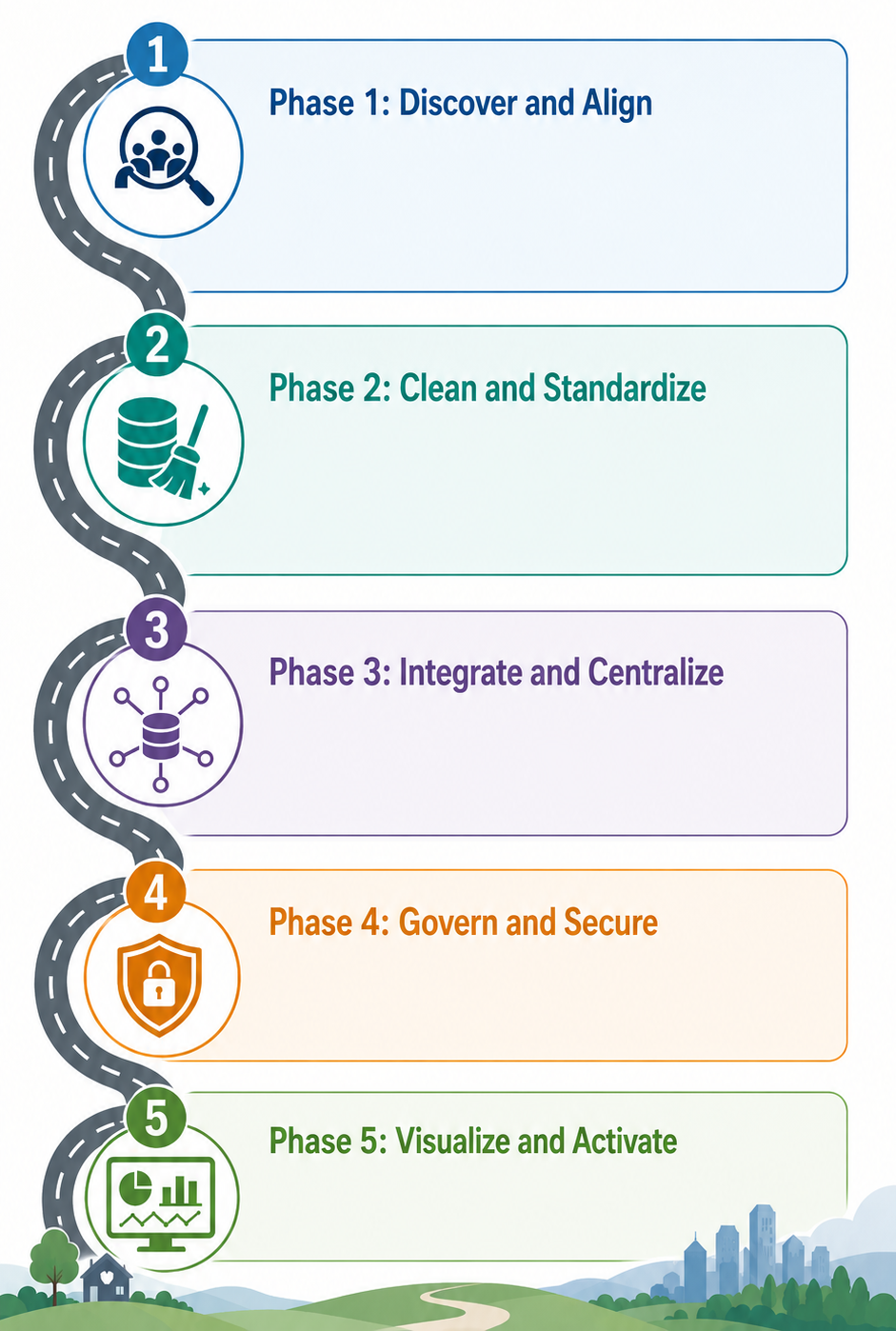
Phase 1: Discover and Align
The first phase focuses on understanding goals, challenges, systems, workflows, and stakeholder needs.
Key activities include:
Interviewing leadership, program staff, operations teams, and reporting users
Reviewing existing systems and spreadsheets
Identifying key pain points
Clarifying strategic priorities
Defining success metrics
Aligning modernization goals with mission outcomes
Phase 2: Clean and Standardize
Data modernization depends on reliable data. This phase focuses on improving data quality and consistency before major system changes take place.
Key activities include:
Identifying duplicate records
Standardizing naming conventions
Defining required fields
Cleaning outdated or incomplete data
Mapping data sources
Creating shared definitions for core metrics
Phase 3: Integrate and Centralize
Once the data foundation is clearer, organizations can begin connecting systems and reducing silos.
Key activities include:
Selecting or optimizing a centralized platform
Designing integrations
Mapping data flows
Consolidating key records
Automating manual handoffs
Creating more unified client, program, and operational views
Phase 4: Govern and Secure
As systems become more connected, governance becomes even more important.
Key activities include:
Creating access rules
Establishing data stewardship roles
Documenting policies and procedures
Strengthening privacy and compliance practices
Building data quality monitoring processes
Training staff on governance expectations
Phase 5: Visualize and Activate
The final phase focuses on turning data into insight and action.
Key activities include:
Building dashboards
Creating leadership and funder reports
Tracking outcomes
Identifying service gaps
Supporting strategic planning
Preparing data for AI-enabled tools and analysis
This is where data modernization begins to deliver visible value across the organization.
How Data Modernization Supports AI Readiness
AI has the potential to help nonprofits improve efficiency, identify trends, summarize information, support decision-making, and uncover new insights. But AI is only as useful as the data behind it.
Organizations cannot become AI-ready if their data is scattered, inconsistent, outdated, or poorly governed.
A strong data modernization strategy helps prepare nonprofits for AI by:
Centralizing critical data
Improving data quality
Standardizing definitions
Creating clear governance policies
Strengthening privacy and security
Building reliable reporting structures
Connecting data across programs and systems
Before adopting AI, nonprofit leaders should ask: Is our data clean enough, connected enough, and governed well enough to support responsible use?
If the answer is no, data modernization is the first step.
How Provisio Helps Nonprofits Build a Successful Data Modernization Strategy
Provisio is a Salesforce Implementation Partner exclusively serving Health and Human Services organizations nationwide. We work with nonprofits and state and local governments across housing and shelter, workforce development, mental and behavioral health, aging care, early childhood, and other mission-driven service areas.
Our team helps organizations implement mission-aligned technology that improves outcomes for the people they serve while strengthening their ability to tell their impact story to funders, boards, partners, and communities.
Provisio’s data management services are designed to help nonprofits and government organizations build a strong, scalable data modernization strategy. We support the management, manipulation, storage, activation, integration, and governance of data so organizations can improve decision-making, streamline operations, and measure impact more effectively.
Our services can help your organization:
Centralize and manage data in accurate, accessible systems
Integrate platforms to reduce silos and improve data flow
Visualize performance through dashboards, heat maps, and reporting tools
Govern data with policies, standards, and responsible processes
Store data in scalable, secure environments
Analyze and report on outcomes, operations, and community impact
Secure and comply with privacy, security, and regulatory requirements
Unify and harmonize data across programs, systems, and service lines
Beyond data management, Provisio also supports strategic planning, process optimization, change management, systems integration, Salesforce implementation, Salesforce managed services, AI readiness, and AI adoption.
Whether your organization needs to modernize spreadsheets, integrate disconnected systems, improve funder reporting, prepare for AI, or create a more holistic view of client services, Provisio can help you build a clear roadmap and implement the right technology to support your mission.

Take the First Step Toward AI-Ready Systems
Data modernization is not just about replacing spreadsheets or upgrading software. It is about building smarter systems that help your organization serve people more effectively, understand impact more clearly, and prepare for the future of AI-enabled human services.
With the right data modernization strategy, nonprofits can reduce administrative burden, improve service coordination, strengthen compliance, and unlock insights that drive better outcomes.
Ready to move from spreadsheets to smart systems? Take the first step toward AI-ready systems and contact Provisio today to chat with a consultant. Together, we can explore how your organization can build a successful data management strategy that supports your mission, your teams, and the communities you serve.
FAQs
-
Nonprofits may need to modernize client data, program data, case management records, grant reporting data, fundraising data, referral information, compliance records, and outcome measurements. The most important data to modernize first is the data that directly supports service delivery, reporting, and strategic decision-making.
-
Common challenges include messy data, unclear ownership, staff resistance, outdated systems, limited capacity, and disconnected workflows. A strong data modernization strategy helps address these challenges with clear priorities, change management, governance, and phased implementation.
-
Nonprofits should modernize data before adopting AI because AI depends on accurate, organized, and secure information. Without a strong data modernization strategy, AI tools may produce unreliable insights or create new risks around privacy, quality, and compliance.
-
Nonprofits can expect improved reporting, stronger data quality, better staff efficiency, more coordinated service delivery, and clearer impact measurement. Over time, data modernization can also help organizations strengthen funding conversations and prepare for advanced analytics or AI adoption.
